Monday, August 15, 2022

Wish List


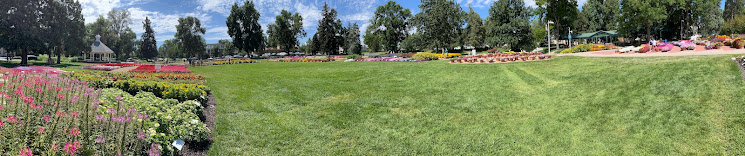
One of our favorite end of summer walks takes us through the Colorado State University test garden in the center of Ft. Collins. It is truly a gardener's delight that displays exactly what we can grow in gardens here in northern Colorado. Filled with beautiful perennials and amazing annuals that are heat tolerant and not quite as thirsty as zones that receive more rain and have higher humidity, the garden features both established plants and tests newly developed varieties. Each plant has a label that includes where the plant be purchased.

 I am one of those gardeners here in Zone 5 who seeks to grow the perfect English garden, but with our daily 90+ degrees summer temperatures and freezing cold, dry winters we have to be creative and selective to get that desired look and grow plants that thrive under such conditions. 


A panoramic view fo the gardens all laid out in perfect rows in some what of circle, with nary a weed to be seen.


I came home with a nice, realistic wish list of plants that I want to add to the Garden Spot, which begs the question: Where to plant them? In years past, I've wandered around the end-of-season plant sales at our favorite garden centers only to bring home gangly, aged plants that either sit on the patio until they aren't viable or if they are lucky enough get planted,  they don't set enough of a root system to survive the winter. So this year, no bargain shopping for plants; instead, a plan of action for next spring.

The flower beds all need to be cleaned, weeded, and thinned; so once it cools down and the Head Gardner is done with archery hunting, we will dig into the gardens to clear spaces for new, exciting plants. 

A Good Plan Begins with a Wish List

The test garden has a variety of mature hibiscus. I love this dinner plate size beauty. We have one hibiscus in the garden, but I teased the HG about planting a row of them along a 6 ft. privacy fence that blocks out the neighbor. Oddly, he didn't blink, but began to come up with an irrigation plan. But, no. There won't be a dozen of the giant plants ordered for next spring. It would be spectacular, though.


More realistic would be dozens of these gorgeous Rudbeakia. We already a few Black Eyed Susans, but I could easily add more. The bees love them.


If we could attract more green bees like this one--commonly known as a sweat bee--I'd plant a dozen more. I see an occasional green bee, not many. 


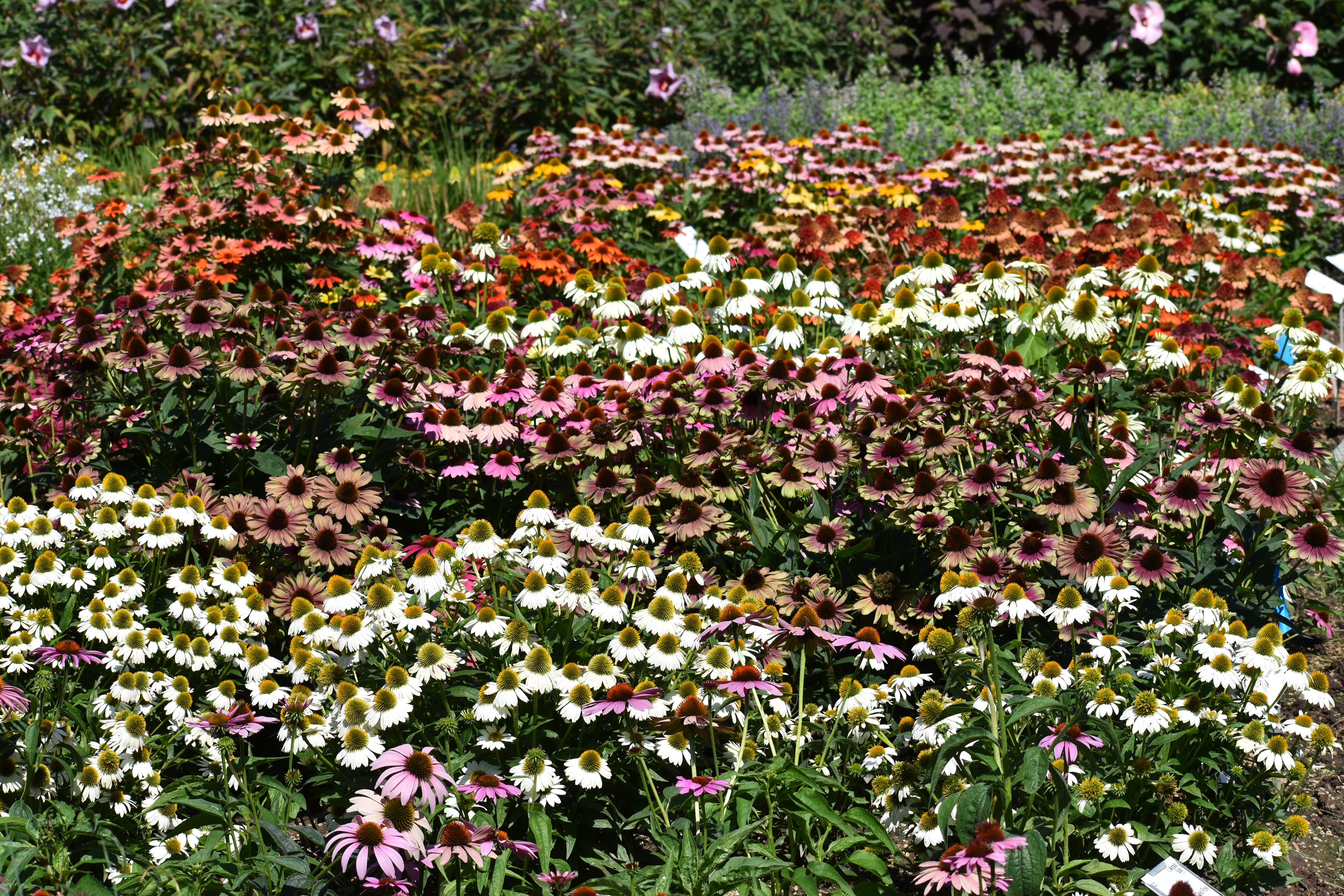
Each year the garden has new varieties of echinacea. A popular new color combo seems to be the magenta coupled with lime green. Stunning.


Or choose from a wide variety of colors to fill an open space.


Each year the cone flower offerings increase, offering a colorful palette. 


This collection would require a large area, but would be beautiful. 


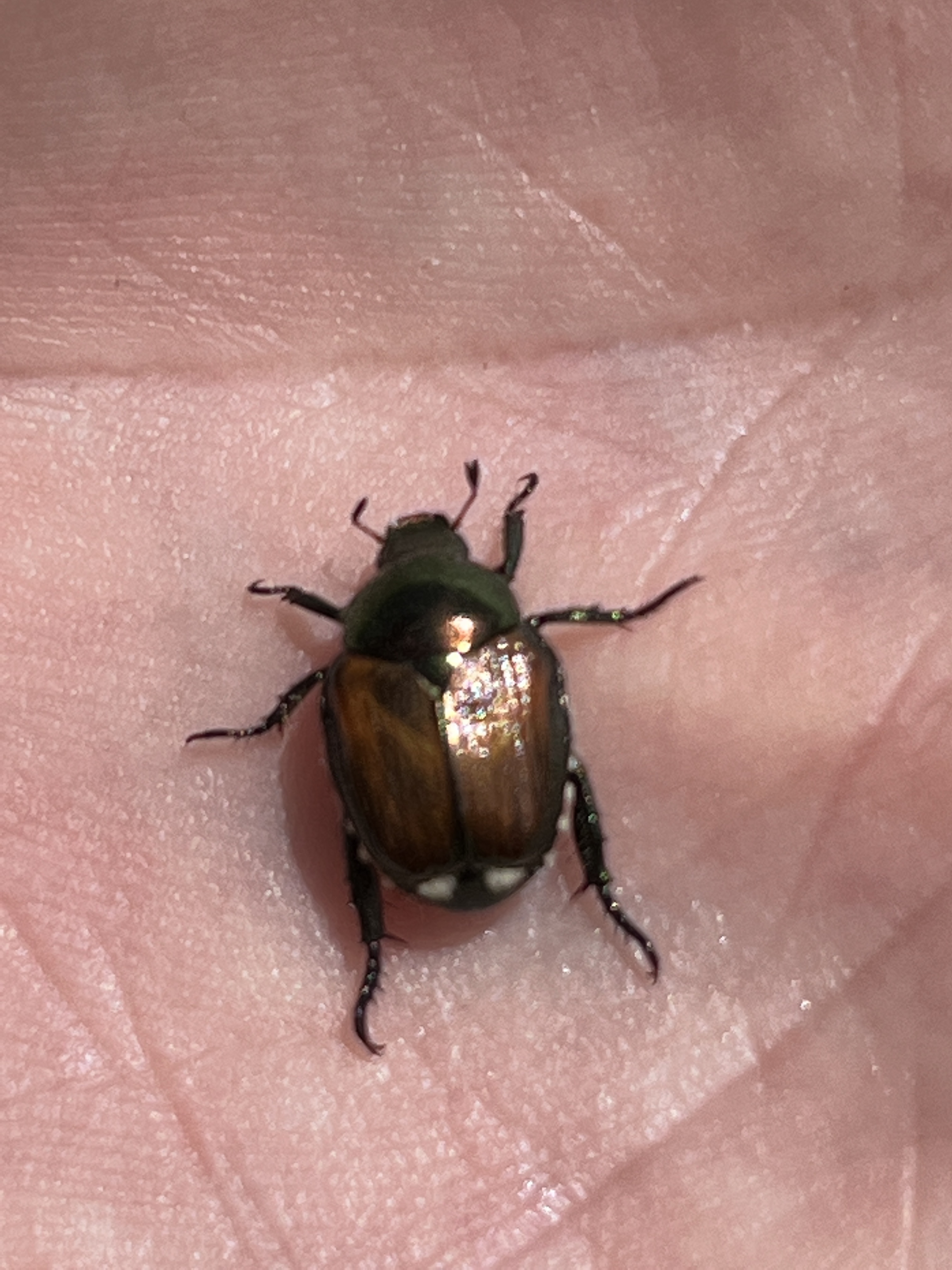
The most common pink cone flower thrives in our garden, reproducing easily by self seeding. I've planted other colors, but not with much luck; still, the magenta would be a pretty addition The cone flower feeds butterflies, insects, and gold finch will feast on their seeds in winter--and this most unwanted garden pest, the Japanese beetle.


These beetles were all over the test garden. Beautiful as they are with their iridescent green and copper backs with the row of white dots, a bit of research reveals just how destructive they are in a garden. We took a lot of pictures of them, but I don't think we want them at the Garden Spot.

We have never grown anemones, but after meeting this beauty, it is at the top of the list. It looks to be sturdy and colorful and will beautiful color to the August garden. I'd like to add it to the newly created hosta garden.


I've planted phlox before, but they didn't last long, but I have to admit to lusting after this sea of pink phlox. I'm not sure what the gardeners feed the these plants, but they are giants.


Almost more pink than even I can bare the new geranium hybrids will enhance any garden.


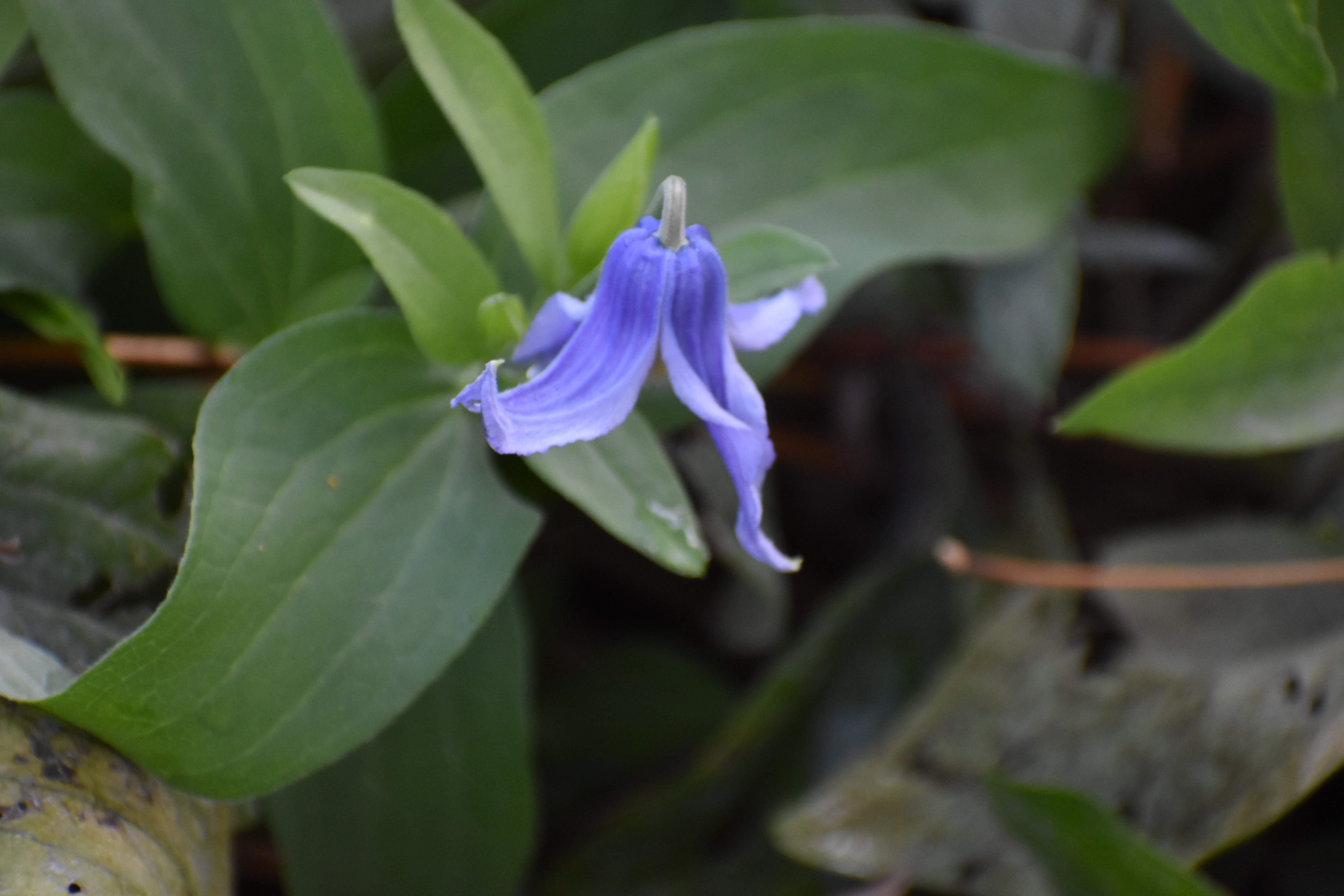
Clematis are a favorite here, but their bloom in June and done by mid to late July, so this lovely low growing vine would be beautiful in bare spots. With a bell shaped flower much like the pink Duchess Annabell that grows in the front court yard, this clematis does climb; instead, it vines on the ground.


We don't have much blue in the garden and it would be a nice replacement for the vinca that dominates the center circle with about the same shade of blueish, but I don't think that it would as invasive as the vine and I love the bell shaped bloom.

The Plant Select on its tag indicates that is new for 2022. We happened to start up a conversation with a woman who told use she was a part of Plant Select that chooses the new varieties for the garden each year. You can click here https://plantselect.org to learn more about Western gardening and the new plant varieties that available. I especially like that it lists local retail outlets. Plant Select is located at CSU's Horticulture Center.


But I've saved the best for last, the giant--and I do mean giant-- Anastasia Oriental Lily. This one is a must. I'm barely 5 ft. 2, so I come out from behind the camera to demonstrate how tall this lily is. The description on Brent and Becky's Bulbs  says that the blooms will be dinner plate size and the plant will grow 3-5 feet--um I think they underestimate CSU horticulturists' ability to grow plants. Still, it's a beautiful lily and I'll be placing my order in January.

Unlike our favorite botanical gardens and city gardens, this garden does not have much in the way of architectural interest other than the Andy Warhol soup can and a small water feature. The beauty of the garden lies in the beautiful plants. But a garden isn't complete with out some interesting creatures.

Saffron-winged Meadowhawk: Sympetrum costiferum


These plants certainly are must in a garden since they provide so much for the insects. It's our duty as gardeners to provide the most beautiful plants that will provide a sound, healthy diet for the pollinators. 


Another look at the Japanese Beetle.


And now back to the reality of the Garden Spot. I've made my list and will be doing some serious research, garden redesign, and searching for these new plants. In the mean time, there is plenty of work to be done in the garden as summer winds down. 

I spent a while in the garden picking raspberries, pulling onions, and gathering peaches before it got hot. I should go out each day now and pick the berries.

I don't know about you, I am having a really hard time buying good fresh fruit. The store raspberries and strawberries mold quickly, and most of the that I bring home cantaloupe have no flavor. 


I have tended to ignore the raspberry patch, but I'm going to try to be more diligent in picking them. Bees present a problem because they like the the berries much as I do and I'm allergic to bee stings. 

The young hens are maturing nicely. We lost another old hen so we have 9 now. These young girls should start laying soon. This is their first forage in the garden. They didn't quite know what to do at first, but there are plenty of fresh bugs to snack on.


Like this green grasshopper


The kale is beginning to look like kale, rough around the edges. But it is a pretty plant.


The poor peach tree looks pretty pathetic, but has a nice stand of sweet, juicy peaches that I pick every few days as they ripen. I try to beat the birds and the earwigs--no photo of those disgusting creatures. 


I think I picked about $6 worth of raspberries and a nice bowl of peaches. They are small, but tasty. I'm thinking homemade peach ice cream sounds pretty good.


I take tons of sunflower photos. I just love their bight, cheerful faces, even as they age they gain more character. 


Have a wonderful week.

Thank you for joining me today. I'll be linking with Angie for Mosaic Monday. See you there.


Monday, August 8, 2022

Three Girls and Their Herd


After I uploaded all of these photos of the granddaughters, I began to wonder if I really needed to write what appeared to be one huge  granny brag post. Yes, I am so proud of these girls for their interest in 4-H and their parents for how they are raising their daughters in these odd times. Not all children have the opportunity to have animals, to work hard to show them in completion, and especially not to be afraid to compete with the possibility of probably not winning first place or the reality of even coming in last. They are developing life skills and learning hard lessons. They are learning how to overcome disappointment as well as being a gracious winner.


Mariah, a 20 year old mustang (yes a true mustang born after her mother was captured in a mustang roundup in Arizona) arrived at the the Larimer County Fairgrounds July 30th and spent four days completing in various events, from English Showmanship to Western Showmanship to Ranch Work, and finally gymkhana. Lucy has had her six years and, yes, you can teach an old horse new tricks.


After winning the English division (actually she was the only one entered in her division--but still she did well-- the Western events began with  showmanship, where the rider displays her horse, making it look the most perfect and beautiful as possible. It's not always easy to get a horse to pose perfectly as the judge walks around looking for the the tiniest flaw.


I took hundreds of photos of the different events and it was so hard to decide which ones to post, but you will get the idea. Completion was tough, even though there were 5 in this division. All were excellent riders with beautifully trained horses. We've watched this girls ride and grow for five years and they all just get better and better. The least little mistake will determine a winner. As was the case in this event where Lucy just didn't execute the pattern as accurately as was required and placed 3rd. Over all, Lucy and Mariah won the Western Division, too.


In the Ranch Work set of classes, one event required her to rope a steer. Fortunately a successfully placed rope wasn't required to place in the event because she won all of her ranch events.


Another challenge in the Ranch Work is working with real steers who have minds of their own and tend to cling together where there is safety in the herd. The point of this competition is to select a steer from the herd and "track" it or follow it for at least 15 seconds. The rider can track only steer, but no more than 3  steers for 15 seconds each.


While Lucy is just learning about working with cattle, Mariah knows cows since her previous owner competed in this sort of completion. 


Some steers are docile and play along with the game; others are more insecure and want to get back to their friends.


While other competitors had some difficulty with the calves, Lucy and Mariah were smooth, collected, and calm and won the ranch work division.


 For the horse show, Lucy won overall the English, Western, and Ranch, but was 5 points behind the rider who won grand champion. 


I don't mean this to be all about Lucy and Mariah, but her sisters decided not to participate in the horse show this year.
Goats
With the horse show over, Mariah went home and the goats came. Again too many photos to choose from, so but you will get the idea.

Mabel and Pansy are just babies, about half grown. Lucy bought them when they were just a month old and bottle fed them. Now weaned, they will freshen (or be ready to milk next spring) when Lucy will begin her goat milk soap enterprise. 


Showing goats was an entirely new experience and most of the other competitors have been showing goats from the beginning--kids have to be 9 years old to compete in the 4-H fair.


The girls became interested in goats when little sister Lily decided that since she didn't have a horse, maybe goats would be fun, so she and her older sister bought two Boar goats or meat goats, bigger, stronger than the milk goats,  Showing goats is not just a matter of herding them around the arena in front of a judge. They have to be correctly groomed, which requires a lot of work and good technique with the electric clippers, a good bath, and a blow dry. They also have to know how handle the goat in the show arena.

Fair prep begins at home as Lily bathes and blow dries Ann.
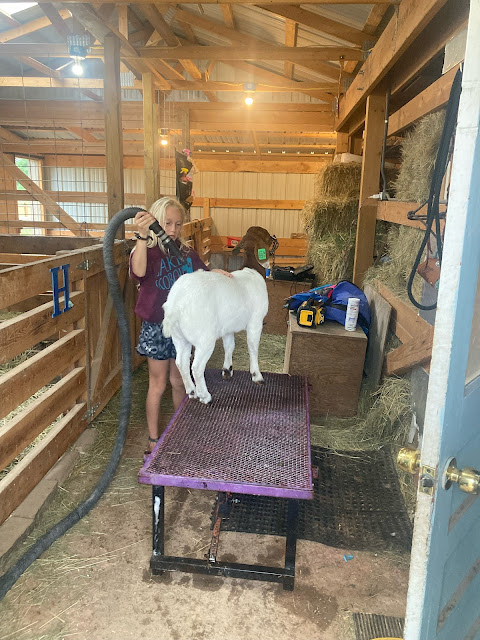


Dressed to the 9s to keep clean while she waits her turn in the show ring, Ann looks like a winner.


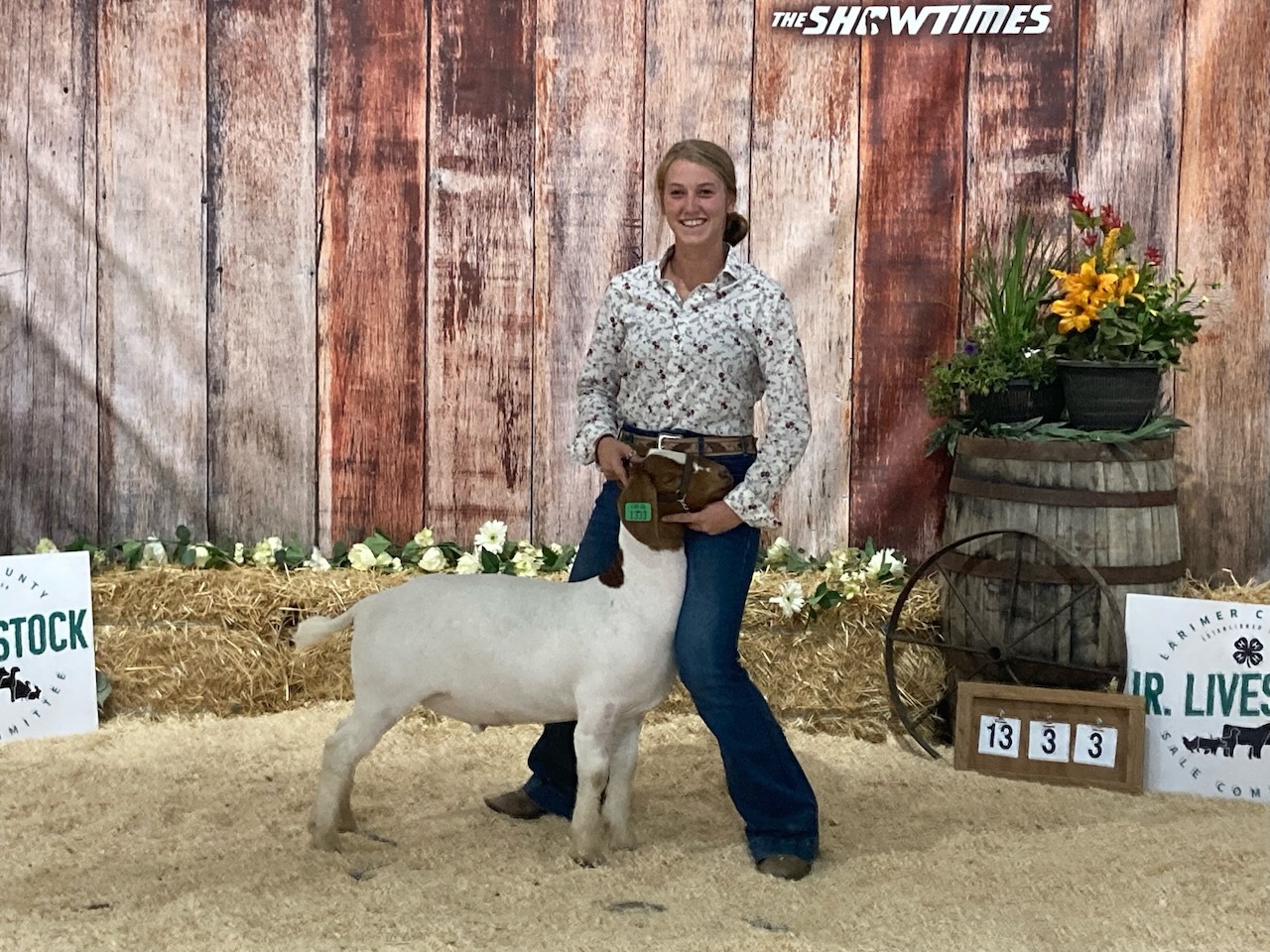
Lily and Ann worked hard before the show learning what is needed to show a winning goat, but theses kids were skilled goat handlers and Lily was out shown. It's tough having high expectations and hopes and then things don't go the way we imagined them, but that's okay. Not everything goes our way, as Lily learned.


The work to get the goats ready to show actually began at home days before the fair. They were clipped and snipped and lead around the yard and taught how to pose. Dan is quite cooperative as Ellie clips away unwanted hair.


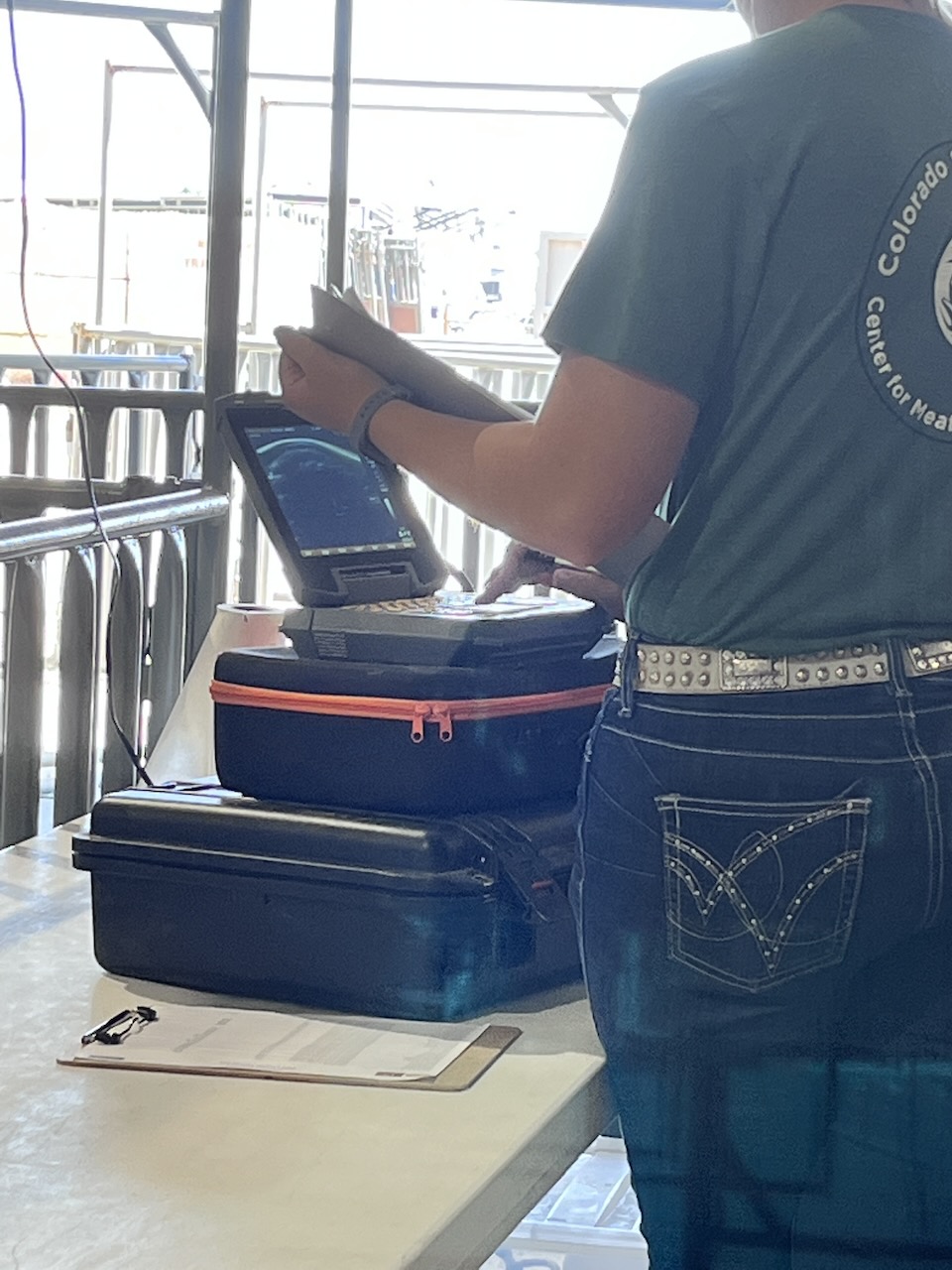
Because these are meat goats, they get a circus ultrasound--I'm not quite sure--to determine their density? Dan takes it all in stride.


Lily's turn in the show ring.


Elinore showed her Boar Goat, Dan, with about the same results. Competition was stiff and the other kids were good.


None of us are sure why Elinore decided to show a hog! Meet Frank, a show pig. These two have quite a special friendship, but not showmanship. The competition is always about the knowledge and hard work before the show and then all of the requirements of good showmanship in the ring and knowing what the judge looks for. 

Goat Sale

Unless the girls decide otherwise, the Boar Goats will go to the 4-H sale with the proceeds shared with the 4-H and the goat owners. It's a hard to spend a year working with with an animal and then sell it, but that's part of agriculture.


Frank, the Hog
As if goats weren't enough, Ellie also took on a hog to show. She and Frank have actually become quite attached to each other, but ultimately Frank will go to the sale, too.


The girls entered 4-H Home show, too with a variety of projects.

Ellie's graduation cap to won grand champion in the leather division, which she made for a good friend who graduated in Animal Science at Colorado State University.


Lily made a cat house for her little cat Sabrina.


Lucy hand tooled a leather belt. Lucy also entered a small quit piece, but it wasn't displayed where I could get a good photo. It, too, won champion.


Ellie added to last year's entomology collection.

Ault Fall Festival
As fair began to wind down, Saturday was our little town's fall festival. The Head Gardener pulls the museum float. Here, he's coming from the neighbor where he picked up the float.


The park on Main Street is full of exciting things to do and see and buy and eat.


The man loves his tractor

Tis is the interior of our museum. It is the old pump house for the original well that provided water for the town. With a grant from the Colorado State Historical Society, we were able to finish the inside for a small museum. We held an open house for the public to see the beginnings of the museum. I'll be writing more about the project as we go. After the open house we headed to the fairgrounds to watch Ellie show Frank and visit the art exhibits.


Fresh cut flowers from the garden.


Gone Fishing

Nathan summer ended with a week with us. He spent most of the time at the fair with the kids, but the he had the Head Gardener have been learning how to fly fish, so while Mariah was settling in at the fair, Nathan and the HG were taking a fly fishing class that began in a classroom in the morning and fishing on the Poudre River in the afternoon. He loved it! So they ended Nathan's week back on the Poudre for one last cast before it's back to school.


Children need things to do. They need goals that challenge them to learn and grow and gain understanding about them and the world around them.  It doesn't matter where they live, can find their won niche when parents and grandparents show them the way and then let them soar. 

These children are so fortunate to have a rural life and animals to love and care for. While the girls live on a small average and Nathan lives in a city cul-de-sac, he has the best of two worlds. He can navigate the city but he is also gets to experience the country life, which he really enjoys. 

As summer winds down, there is still plenty to do here at the Garden Spot, especially as everything was put on hold as I tried to keep up with three girls, one boy, a horse, 4 goats, and hog. (I wore out when the rabbits had their turn.) I am thankful that I'm not these kids's mom! Bless the mothers who herd these four youngster around, giving them goals, values, and challenges. 


I don't often refer to a previous post, but since last week's post didn't get posted on Mosaic Monday, please take look at it as I write about the plight of the Monarch butterfly that has been put on the endangered species list. I give suggestions that gardeners can do to provide important food and habitat for the migrating butterfly. And I encourage you then to spread the word about how to save this beautiful species. 

Have a wonderful week and thanks so much for joining me today. 
I'll be joining Angie for Mosaic Monday. See you there. 


Monday, August 1, 2022


 Everyone’s favorite butterfly has now been placed on the endangered species red list for the most obvious reason: loss of habitat. Its life cycle must be one of the most intriguing, especially for the Lepidoptera Danaus Pexlippus, or more commonly known as the monarch, easily identified by their rusty golden color with black stripes and spots. There are 2 others in the category lumped together as the tiger milkweed butterflies, so identified for what they eay. That they migrate from the Mexican forest to mate and metamorphize in faraway places such as Colorado is even more amazing.


Gulf Coast Fritillary Texas Hill Country, another milk weed migratory butterfly.
             

For a great photo collection of these beautiful butterflies, visit these sights so that you can identify them when they visit your garden:

·       iNaturalist

·      Wikipedia shows the list of the order Danaus. Maybe you have these butterflies in your garden.


Rare queen butterfly, Ft. Collins, CO at
the CSU test garden

US Forest Service web page has a very simple explanation of the monarch’s life cycle. Beginning in Mexico during February and March, the monarchs come out of “reproductive diapause” as they begin their northern migration. Along the way, they mate and lay their eggs on milkweeds. During their breeding season, the monarch will live 2-5 weeks, laying eggs only on the various varieties of milkweeds unique to specific geography locations along their migration route. The plant varies from area to area. This one grows here in Colorado.

 The last generation of monarchs born up north will not mate but will return to Mexico and continue their celibacy until early Mexican spring when it is time to head north. They will live as long as 9 months.

These links chart the migration paths:

  Roadside Habitat For Monarchs

·      Wikipedia Milkweed Across America

·      Fall Monarch Migration

·      Two Way Migration 

What to look for in your garden: To begin you must have milkweed. Here in Colorado, milkweed is often called a roadside weed or ditch bank weed; or in the cultivated garden, a noxious weed. They are a prolific perennial that sink deep roots and can only be killed off with weed killer or pulled out as seedlings. The monarchs will feed on other plants, but exclusively lay eggs on the milkweed that caterpillars feed on.


Regretfully, at the Garden Spot we have eliminated a healthy stand of milkweed in the front garden circle because we rarely see monarchs—one a season, if we are lucky. But I’m changing my mind, for I have contributed to that loss of habitat and will let the milkweed grow freely—well, maybe well monitored.

“Loss of habitat” just does not adequately explain the seriousness of that condition. Articles using that vague description oversimplify the problem. Where does the habitat go? What destroys it? Vague references to "land development" don’t help, which really is the bulldozing away of raw land, including bogs, swamps, woods, forests, and grasslands which all provide habitat for flora and fauna to plant houses, malls, factories, football fields, and the double threat wind generators that populate the landscape. Take a road trip—well to anywhere from anywhere—and once you hit the wide-open, sparsely populated spaces, you find massive colonies of wind generators such as our drive across what was once called the Great American Desert, or the prairie grassland, all the way through eastern Colorado, Kansas, Oklahoma as we head to Texas, which also has a healthy stand of thousands of wind generators that populate Texas landscape. Head east to Iowa, for example, and the wind generators stand in large clusters silently and often at rest along the route.


Once that natural land—be it a farm that has been sold grow suburbs or the —as here in Colorado— or land that has been leased or sold to plant those giant white mills in the name of green energy, it will never be reclaimed. The monarchs then have a quite an obstacle course as they make their way north. If the blades of the wind machine don’t whack them, they may not find enough food to make the journey or plants on which to lay their eggs. 


Praying Mantis and tiger swallowtail caterpillar 
So what can we do to help the plight of the monarch butterfly? The Head Gardner and I have been having that discussion. Our simple contribution will be to focus planting more butterfly food. I have a feeling that the milkweed will lose its reputation as a ditch bank weed to become a garden center favorite perennial. I will stop pulling out the baby plants and the HG will mow around them. We have at the back of our 5 acres a narrow strip of land that a previous owner fenced off with an electric fence to keep his horses out of the space. It’s just wild grasses, weeds, and trees, so I suggested that we plant butterfly bushes and get the milkweed growing out there and to work more to create a butterfly habitat. 


So what we can to help: We can also change the way we garden by providing habitat that nurture  the tiny species in our gardens, some that will do the pest control naturally. We can go to the garden center to buy lady bugs that will eat aphids and praying mantis in our gardens so we can reduce the use of pesticides—which we don’t use at all here, and we can also purchase monarch eggs online, and raise our own generation of butterflies that will hopefully migrate back Mexico.  Probably one of the worst offenders in the backyard garden if you grow tomatoes is the tomato hornworm. Most describe this fellow as disgusting, and it tends to destroy tomato vines. My dad’s answer to that problem was to plant one more tomato plant for the worm that morphs into a beautiful moth.

Learn more about the tomato hornworm here: University of Minnesota Extension: Tomato Hornworms in the Home Garden. 


Black Swallowtail on zinnia Texas Hill Country, not a migrating butterfly, just a pretty one.

I always let dill grow wild in the garden that reseeds itself every year to provide food for the black swallowtail butterfly, another very rare visitor the Garden Spot.  More on this beautiful butterfly: Butterflies at Home. A healthy stand of zinnias will also attract and feed butterflies of all species. 

We can purchase monarchs to release instead of balloons that are so dangerous to wildlife to commemorate those special occasions and what great metaphor the butterfly is to remember our lost loved ones.  

https://www.mrbutterflies.com/statesweserve/butterflyreleasecolorado.html

Raising our own monarchs to release in our garden will add to the migrating population : https://monarchbutterflylifecycle.com/blogs/raise/raise-the-migration-monarchs-supply-list 

Really, you don’t need such a fancy set up to raise monarchs. A mason jar will do just fine. As a child living on a farm where I wondered barefooted most of the summer, I captured the monarch caterpillars, which were feeding on the milkweeds along with the stock and more leaves that they were munching on and placed them in mason jar with a perforated wax paper lid and watched them mesomorph as they formed their pupa and slowly emerged as beautiful butterfly. Once the butterfly fully formed, I joyously released it. While I have seen that one monarch flit through the yard, stopping to snack on the butterfly bush by the back patio, I’ve not seen it lay eggs and now most of the native milkweed has been eliminated here at the Garden Spot. 

There are a variety of Facebook pages and dozens of websites where you can learn more about the monarch and ways to increase its migratory population. If we want to save yet another species from extinction, this is one backyard project that will have lasting effects. Teach your children and grandchildren to love, respect, and revere important lepidoptera life forms be they butterflies, bees, or ladybugs, or even the disgusting ones for they all have their place in our gardens. 

There is hope, I do believe, of saving the monarch for other species have been successfully removed from the endangered list, but we must all do our part to help, for the monarch is not the only creature endangered. The loss of forested woodlands and farmlands across the USA, especially in the flyways beginning deep in South America has caused a huge drop in the migrating bird populations, too. Pesticides, especially contribute to reduction of insects and birds, as the bald eagle demonstrates. In the 1970s the bald eagle population had been reduced from thousands to under 500 mating pairs. DDT, a strong pesticide, washed into the rivers where the eagles fished. Not only were the eagles that fished the contaminated rivers poisoned, but the pesticide weakened the eggshells so that they could not support the baby birds. 

The fight to save the bald eagle and remove it from the endangered species list was a success when DDT use was prohibited. Bald eagles that migrate from Alaska to winter here in northern Colorado. What a thrill it is to see hundreds of the majestic birds perched in the trees or ice fishing on local lakes. Each time we see one flying against the blue sky our we get that same thrill. Once again, however, the bald eagle faces a troubled future. While they are no longer endangered and federal law makes it illegal to kill eagles –or any other raptor—thousands of the grand birds, along with other migratory birds, are being sacrificed in the name of green energy as they collide with the giant white wind generator propellors. 

As gardeners, especially, and humans we own a responsibility to preserve and protect wildlife. While we may not be able to change laws or fight city and county governments that side with developers, we can provide nurturing habitats whether it be tiny balcony container gardens or large acreages to help sustain dwindling wildlife populations with habitat.  I’ve provided some links that will hopefully inspire you to take a another look at how you garden and what simple changes you can make to help nurture lepidoptera, and especially Danaus plexlippus.


 Have a wonderful week and thanks for stopping by. 

Anchor

 Even the backyard garden has moments that can serve as a metaphor for life. While aracinids  are not always the most popular creature to st...